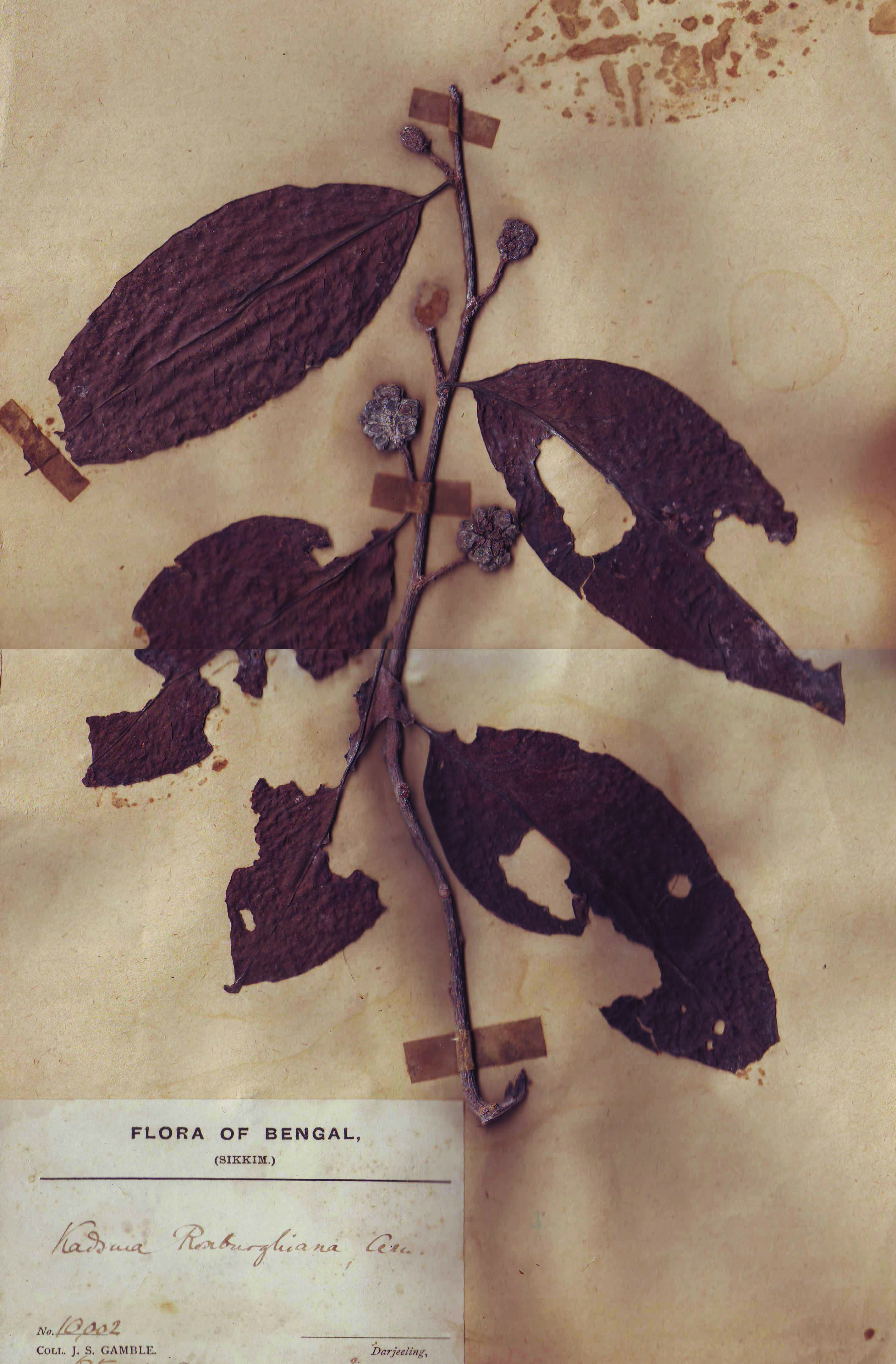
Herbarium and the Office building is an old heritage building constructed in the late Elizabethan style, surrounded by hedges of “American pillars”. The Herbarium is arranged according to Bentham and Hooker’s system of classification. It contains a unique collection of 14251 specimens of dried plants collected since 1850’s. This represents more than 3584 Eastern Himalayan species.
Overview
- Botanical Name : Kadsura roxburghiana Arn.
- Category : Sikkim Himalayas
- Family : magnoliaceae
Collection Summery
- Collector Name : J.S.Gamble
- Collection Place : Darjeeling
- Collection Date : 01/10/1881
- Elevation : 3,000 ft
Description It is an evergreen climbing shrub with stems that can be 10 metres or more long. The plant is harvested from the wild for local use as a food and medicine. Range: E. Asia - China, northeast India, Sri Lanka, Bangladesh, Thailand, Laos, Vietnam, Malaysia, Indonesia. Habitat: Primarily in submontane to montane forests, generally over rocks, or supported by shrubs or trees. Forests, ravines and along the sides of rivers at elevations of 800 - 2,000 metres. Cultivation Details: Requires a sheltered position in a moderately fertile well-drained neutral to acid soil. Prefers a position in semi-shade. Flowers are produced on the current year's growth. Plants can flower and fruit all year round, especially in the moister, southerly part of its range. Plants do not really require pruning.
Edible Uses: Fruit - raw or cooked. The red, sub globose, aggregate fruit is comprised of around 33 - 41 apocarps 10 - 22mm long and 8 - 10mm wide, each containing 1 - 2 seeds. The pear-shaped seeds are 4 - 7mm long and wide. Medicinal: The stems are used in southern China for the treatment of menstrual irregularities, blood deficiencies, and other female disorders. Derivatives of the root and stem are used as an analgesic and to ameliorate rheumatism, gastroenteritis, and malaria. Kadsura species are widely used for a variety of medicinal purposes throughout the geographical range of the genus. Little distinction is made between species, presumably due to the common presence of similar pharmacologically active constituents. Although it can be presumed that a wide range of different Kadsura species have been used medicinally, it is generally only the more common species that are reported in the literature. : Propagation Seed - best sown as soon as it is ripe in a shady position in a nursery seedbed.. Prick out the seedlings into individual pots when they are large enough to handle and grow them on until they are large enough to plant out. Cuttings of half-ripe wood, 5 - 8cm with a heel. Layering of long shoots in the autumn